V. Topachevsky Paleontological Museum
KyivThe Topachevsky Paleontological Museum in Kyiv: mammoth-bone dwellings, Hipparion fauna, deinothere and the Miocene baleen whale Cetotherium riabinini.
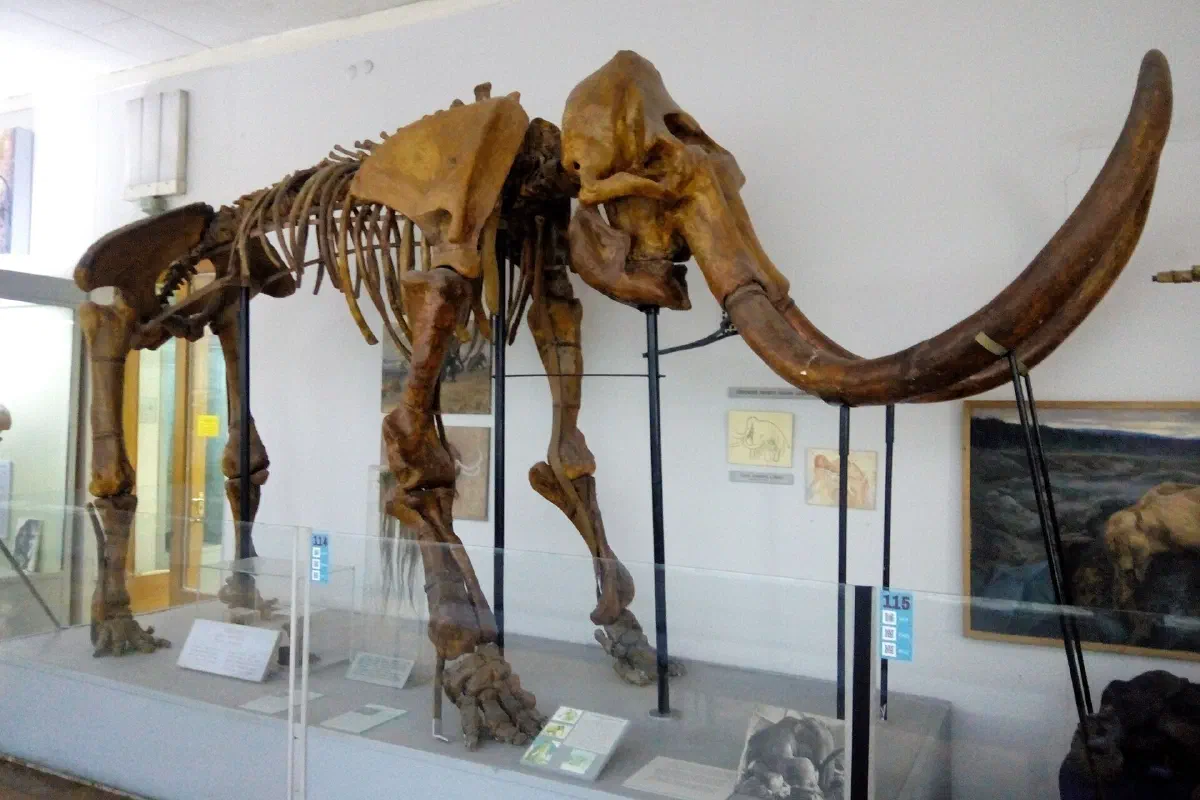
The Paleontological Museum named after Academician Vadym Topachevsky is one of the departmental museums that together make up the National Museum of Natural History of the National Academy of Sciences of Ukraine, housed at 15 Bohdana Khmelnytskoho Street in central Kyiv. Under the same roof visitors also find the Geological, Zoological and Botanical museums. The paleontology halls tell the story of life on the territory of present-day Ukraine across hundreds of millions of years — from Paleozoic fishes and invertebrates to the mammals of the Neogene and the Ice Age, and the people who hunted mammoths.
The museum is not only an exhibition space but also a working research collection. Its specimens are cited in the scientific literature under the acronym NMNH-P, and some of them are type specimens — the single reference fossils on which a species name rests. A good example is a fossil baleen whale from southern Ukraine that was redescribed in 2013 by a team that included a staff member of this museum, and whose mounted skeleton stands in the exhibition.
History
According to the museum’s own history page, fossils began to be collected for the Academy of Sciences as soon as the Academy itself was founded in 1919. The first, still small, paleontological display was set up in December 1935 inside the Zoological Museum by Ivan Pidoplichko, later an academician, and the museum’s history remains closely tied to his name. The Internet Encyclopedia of Ukraine likewise dates the paleontological collection to 1935.
The museum lists a number of prominent scientists who contributed to forming the collection, among them the academicians Oleksii Borysiak, Afrykan Kryshtofovych and Yurii Orlov, as well as Oleksandr Brauner, Mykola Burchak-Abramovych and Konstantin Flerov. The Second World War dealt the collection a heavy blow: the museum states that a significant part of it was looted and destroyed. In the first post-war years Pidoplichko’s school surveyed and mapped the known fossil-bearing localities, which helped to rebuild the holdings.
In 1966 the Academy brought its natural history collections together in a new institution, the Central Museum of Natural History of the Academy of Sciences of the Ukrainian SSR. The Encyclopedia of Ukraine lists its predecessors as the zoological (1919), botanical (1921), geological (1927) and paleontological (1935) collections; the museum received national status in 1996. The paleontological exhibition took its present shape in 1966–1969 under Pidoplichko’s general direction, and he led it until 1975. Painters and diorama makers worked on the halls alongside the scientists, which is why the exhibition combines original bones with painted reconstructions of ancient landscapes.
From 1976 to 2004 the museum was headed by Vadym Topachevsky (1930–2004). A memorial article in Theriologia Ukrainica describes him as the most prominent paleomammalogist of Eastern Europe: a specialist in fossil mammals, notably the small mammals of the Late Pliocene and Pleistocene, whose work underpinned the biostratigraphic scheme of the Neogene and Pleistocene of Eastern Europe. Besides heading the paleontological department for decades, he directed the Schmalhausen Institute of Zoology and became a full member of the National Academy of Sciences of Ukraine. According to the same article, in 2005, a year after his death, the paleontological exhibition of the National Museum of Natural History was named after him.
What to see
According to the museum, the exhibition today contains more than 2,000 original specimens, most of them found in Ukraine, while the reserve collections hold around a million items. The display occupies 106 showcases and includes five art dioramas. The museum explains an apparent gap honestly: during much of the Mesozoic, the territory of Ukraine lay at the bottom of the Tethys Ocean, so dinosaur remains are almost absent. On the other hand, Ukraine is one of the richest countries in Europe for Paleozoic fishes and for Neogene mammals, and the exhibition plays to these strengths.
Mammoth-bone dwellings. The best-known items are two reconstructed dwellings built from mammoth bones. They come from the Upper Paleolithic sites of Mezhyrich in Cherkasy Oblast and Mizyn in Chernihiv Oblast, and, according to the museum, were built 15–20 thousand years ago. Reconstructions of these structures have been shown abroad, including in Japan and Western Europe.
Large Ice Age and Neogene mammals. The museum singles out skeletons of a deinothere (an extinct relative of elephants with downward-curving tusks in the lower jaw), the giraffe relative Chersonotherium, a cetothere whale, an aurochs and a mammoth. Especially valued are the Hipparion faunas — assemblages of Late Miocene animals named after the three-toed horse Hipparion, which lived in the open landscapes of what is now southern Ukraine.
The fossil whale Cetotherium riabinini. Among the mounted skeletons is a small baleen whale from the Late Miocene. The specimen — a nearly complete skull with part of the skeleton — was found in 1930 near the city of Mykolaiv (Nikolaev in older literature) and was briefly described as a new species by I. Hofstein in 1948. For decades it remained little known. In 2013 P. Gol’din and D. Startsev of Taurida National University and T. Krakhmalnaya of the Topachevsky Paleontological Museum published a detailed redescription in Acta Palaeontologica Polonica (online in March 2013, in the printed volume in 2014). The paper lists the fossil as the type and only specimen of the species, catalogued as NMNH-P 668/1, and in describing the vertebrae notes how the skeleton had been assembled for display.
The authors date the find to the late Sarmatian of the Eastern Paratethys — the inland sea that once covered the Black Sea region — which corresponds to the early Tortonian stage of the Late Miocene. They point out that the upper boundary of the Sarmatian in this region has been dated to around 9.3 million years ago or even later. The Sciency Thoughts blog, which reported on the study in August 2013, stressed that the exact find spot within the city is unclear, which makes the age harder to pin down.
Scientifically, the study showed that C. riabinini is a close relative of Cetotherium rathkii, the only other species of the genus, known from the Taman Peninsula. Whales of this genus were small: the authors give 3–4 m for body length and about one metre for the skull. Their postcranial bones are unusually dense (pachyosteosclerotic), and the Paratethyan cetotheriids are among the youngest known whales with this trait. The authors also proposed that the whale fed by a mixed suction strategy, combining features seen in grey whales and in some extinct cetotheres, and linked this to mobility of the bones of the skull. For visitors, the whale is a reminder that southern Ukraine was once a sea coast with its own marine mammals.
Smaller finds. The exhibition also shows imprints of invertebrates, mollusc shells, petrified tree trunks and pieces of amber with insects trapped inside. Since the paleontology halls share a building with three other museums, it is easy to combine a visit with the geological, zoological and botanical exhibitions.
Getting there
The museum stands at 15 Bohdana Khmelnytskoho Street in central Kyiv. The museum names Teatralna as the nearest metro station: from the exit, walk about 150 metres up the left-hand side of Bohdana Khmelnytskoho Street. Zoloti Vorota station is also within walking distance.
Wartime note: the museum’s news page reported in 2024 that during air-raid alerts events are suspended and visitors are directed to the shelter in Teatralna metro station, and that in autumn 2024 the museum kept working during scheduled power outages. In August 2026 the museum reported a temporary change of entrance during renovation works, while the paleontology exhibition remained open. Opening days have changed several times: as of November 2026, according to the official site, the museum admits visitors on only a few days a week, and one hall of the complex (“Aesthetics of Stone”) is closed. So check the official site before your visit.
See also
Sources
app.pan.pldoi.orgencyclopediaofukraine.comsciencythoughts.blogspot.com